
Organizations have probably never asked as much of their employees.
Being customer-centric. Collaborating beyond silos. Adapting quickly. Adopting new tools and new ways of working. Innovating. Taking initiative. Participating in the organization’s transformation.
But one question remains:have we created the employee experience that truly enables them to do so?
Employee experience is often approached through the lens of engagement, well-being, attraction, and retention. These dimensions matter. But in a context where organizations must continuously transform, we believe we need to go further.
We also need to look at theability of employees to act.
Employee experience directly influences the organization’s ability to create value
According to Gallup’s meta-analysis of 183,000 business units and teams in 90 countries, teams with the most engaged employees achieve better results than those with the lowest engagement, particularly in termsof productivity, profitability, employee retention, absenteeism, quality, and customer loyalty.
This link to the customer experience is particularly important. Behind almost every experience lived by a customer is an experience lived by an employee.
A complex process for the customer is often also complex for the employee. Information that is difficult for the customer to obtain can be just as difficult for the person trying to answer them. A break between two steps in the customer journey may reveal a breakdown in collaboration between two internal teams.
We therefore cannot transform the customer experience without looking at what is happening behind the experience.
The challenge is not only to listen to employees. It is to enable them to act.
Mapping an employee journey, conducting interviews, or measuring engagement helps surface significant pain points.
But what happens next?
This is where our view of employee experience stands apart.
AtInterface&co, we combine our expertise incustomer experience management and innovation management.
Methods drawn from customer experience make it possible to understand and visualize what employees actually experience: their needs, their pain points, their interactions, the moments that matter, and the processes that influence their daily work.
Approaches drawn from innovation management then make it possible to turn these insights into action: mobilizing the right people, challenging certain ways of doing things, collaborating beyond silos, co-creating, experimenting, and advancing new solutions within the organization.
Employee experience then becomes astrategic lever for organizational transformation.
It is no longer only about improving satisfaction, engagement, or retention. It is also about creating the conditions necessary for employees to actively contribute to the organization’s evolution: better understanding customer needs, collaborating, proposing ideas, experimenting with new ways of doing things, and leading transformation initiatives.
By combining experience management and innovation management, organizations can move from a support logic to a logic ofcapability: developing the skills, behaviors, environments, and mechanisms that enable employees to act as true agents of innovation and transformation.
From employee to intrapreneur
Employees are often extremely well positioned to see what should change.
They know customer pain points. They experience the limits of processes. They know which tools make their work unnecessarily difficult. They see opportunities to do things differently.
Yet identifying an opportunity and successfully turning it into reality are two different things.
This is whereintrapreneurshipcomes in: developing in employees the ability to take ownership of an opportunity, understand the problem, mobilize collaborators, develop a solution, test it, and advance it within their organization.
The goal is not for every employee to become an entrepreneur.
Rather, it is to create an environment where more people havethe ability, the tools, and the legitimacy to act on what they observe.
What does this look like in practice?
Two of our recent mandates illustrate two complementary ways of approaching this question:developing employees’ ability to transform their organization and redesigning their work based on the value created for the customer.
Developing intrapreneurs capable of turning issues into projects
At a major Quebec university, we supported a cohort of employees from different teams so they could take ownership of real issues within their organization and turn them into innovation projects.
The goal went far beyond training. Each participant worked on a genuine organizational challenge and was supported through a structured journey: understanding the needs of the people concerned, reframing the problem, mobilizing stakeholders, generating solution ideas, prototyping, field testing, and finally presenting a proposal grounded in concrete learnings to decision-makers.
The approach combinedsupport for project leads, involvement of internal sponsors, and field experimentation. It thus enabled employees to develop their leadership, influence, and intrapreneurial mindset, while advancing initiatives that were important for the organization.
The benefits therefore went beyond the projects themselves. The organization was simultaneously developingemployees capable of driving change, a common approach to innovation, and a greater ability to make decisions based on validated needs rather than intuition.
For us, this is also employee experience:not only asking employees to contribute to transformation, but giving them the time, tools, support, and legitimacy needed to truly drive it.
Discover the project on our client’s website
Redesigning employees’ work based on the value created for the customer
At a fast-growing technology company, we supported teams in understanding how to evolve their service model while maintaining a distinctive customer experience.
Rather than focusing solely on optimizing processes or the customer journey separately, we sought to understandwhat employees were doing on a daily basis, how the different teams contributed to the experience, and above all how their actions created, or could create more, value for the customer, for themselves, and for the organization.
We therefore worked simultaneously on both sides of the experience.
Internally, interviews with leadership, sales, and support teams helped us understand the roles, responsibilities, inter-team interactions, and processes supporting service delivery.
On the customer side, a voice-of-the-customer approach combining interviews and quantitative data made it possible to validate what was actually influencing satisfaction and perceptions of value.
This cross-analysis brought an important insight to light:improving the customer experience did not simply mean asking employees to deliver better service. It also required rethinking the conditions under which that service was delivered.
Information transfer between teams, coordination of interventions, customer follow-ups, and clarity of responsibilities all affected employees’ ability to create the desired experience. Conversely, listening to customers made it possible to better understand which employee actions were most valuable in their eyes and deserved to be strengthened.
The approach thus made it possible to rethink the service model more broadly, clarify improvement priorities, and strengthen internal leadership around the customer experience.
This is another important dimension of employee experience:designing work not only so that it is more efficient internally, but so that employees can understand the value they create and have the conditions necessary to deliver it to the customer.
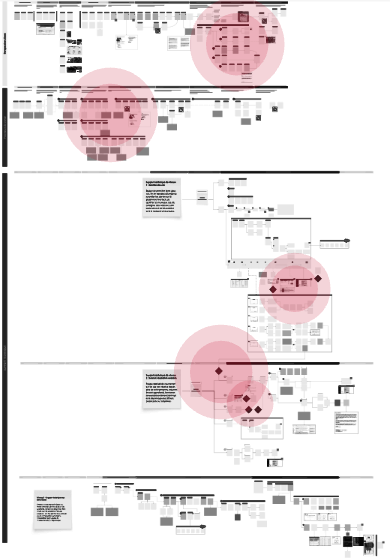
These two approaches will also be presented at theQuebec Business Best Practices Fair of the Mouvement québécois de la qualité (MQQ), illustrating two complementary ways of leveraging employee experience as a transformation lever.
Designing an experience that enables employees to contribute
Employee experience should therefore perhaps not only lead us to ask:
“Are our employees having a good experience?”
We should also ask ourselves:
“Does the experience we create for them enable them to fully contribute to the organization we want to become?”
Can they understand customer needs?
Can they easily collaborate with the right people?
Can they challenge a way of doing things?
Can they propose an idea?
Can they experiment with it?
Can they lead a project and contribute concretely to transformation?
For Interface&co, this is the intersection where employee experience becomes particularly powerful.
Employee experience is not only about what the employee feels. It is also about what their environment enables them to do.
By combiningexperience management and innovation management, we can not only improve the experience lived by employees, but also develop their ability to, in turn, improve the customer experience and their organization’s performance.
Source: Gallup, The Relationship Between Engagement at Work and Organizational Outcomes, 2024.